Showing posts with label review. Show all posts

Sunday, October 17, 2010

TAKE Dance: The Distance of the Moon

get-attachment.aspx.jpg
Photo by Kokyat
Takehiro Ueyama knows how to put on a good show. His contemporary company Take Dance, in collaboration with Pulse, presented "The Distance of the Moon" last week at Judson Memorial Church to standing ovations. And rightfully so: the evening offered intriguing choreography, strong dancers, exceptional live original music, and cool lighting in a great performance space.

The program was broken into seven sections with varying moods choreographed by Take himself and Jill Echo, Kile Hotchkiss, and Julie Tice. Each was deliberate in establishing a theme throughout the movement - contemplation, intensity, friendship, humor...all paying ode to the versatility of this company within a set style and vocabulary.

Hotchkiss' "Penumbra" was the most forceful and memorable of the selections, especially with it's start: Light! Five dancers stood in line facing a single stream of brightness on the left. It was a jolted start from blackness that sparked curiosity. Slowly the dancers held onto each other, slithering up and down in the shadows of Jake Warren, the tall dancer at the front. As the lights came up they separated into intense duets and solos of swoopy movements. Jason Jeunette's fantastic lighting cast their shadows larger than life on the three walls.

Following this was Echo's excerpt "Evening Song" for five women. In a circle, they swung their arms and threw their heads back, rotating around like clockwork. Their huddle broke to reveal their more playful personalities. Elise Drew has a particularly compelling stage presence. Yumiko Sunami's twinkly music was the most enjoyable of the evening (though JC Sanford's music in "Long Night Moon" also stood out).
get-attachment.aspx.jpg
Photo by Kokyat
It's always fun to see humor in modern dance, and Take's "And Dance By the Light of the Moon" did that well. Two dancers in white start hunkering around the stage like cavemen, shifting their weight side to side as they walk with bent knees and stiff torsos. As they round the upstage corner another comes out to the audience's surprised giggle. They go on to dance powerfully with subtle touches - a confused facial expression, an awkward movement - that called for laughs. It would've been just enough had the part when a dancer strolled by crouched on a skateboard in a just black shorts and a strange silver mask been omitted.

That hokey-ness and the pseudo-acting in the bar scene of "Moonshine" could've been skipped. Like many ballet, contemporary, modern, and musical theater works seen over the years, this last piece set a table and chairs on one side and a makeshift bar at the center to create your typical bar dance scene: the flirty girls, the suave guys. The cliche story and "acting" was saved by a clever duet for Warren and Mariko Kurihara. About 2 feet different in height, their partnering was comical in the best sense. Kurihara was hilarious, standing barely to her partner's ribs.

Whatever the work, Take Dance always is a joy to watch. The dancers have wonderfully uninhibited movement and flow. And live music and creative lighting made "The Distance of the Moon" a great success.
get-attachment.aspx.jpg
Photo by Kokyat

Tuesday, September 21, 2010

Perceptions Contemporary Dance Showcase

"Contemporary dance" is a vague term. Is it ballet mixed with modern? Is it what we see on television nowadays? Is it classier than lyrical?

At Perceptions Contemporary Dance Festival last Saturday, "contemporary" seemed to mean distraught intentions, audible breath, a pounding relationship with the floor, and loose, almost improvisational movements across the board. The program at Manhattan Movement Arts Center included 10 works by mostly emerging chorographers and concluded with a piece by Perceptions Contemporary Dance Company, the evening's host. As would be expected for this kind of mish-mash program, some were good and some...not so much.

Amidst a bit of what I call selfish dancing (overly long works that seem to be only for the benefit of the performers) a standout of the evening was "Hindered Souls" by Jeremy McQueen (disclosure: Jeremy was briefly one of my partners at Radio City). The pas de deux for he and Alexis Covento is loosely based on one of the most gorgeous scenes in classical ballet: the balcony pas de deux from "Romeo & Juliet." But, with the woman's arms bound tight in rope for most of it, there are few obvious visual connections.

The two begin with their backs to each to each other, McQueen still and Covento convulsing in attempt to free herself from the rope. In her efforts she falls forward hitting the floor. He turns. They dance together in grounded yet free movement, complementing each other well. She struggles with wrists connected. On the other hand, he can use his long arms to express emotion. In distress he clenches his fingers and holds his head. She has no such luxury but still manages to convey her feelings.

At the end she throws her tangled arms over his head in a strong embrace. A second later she's released with hands free. The rope lands on the floor. Love frees.

The final image is of him walking away rather abruptly, taking the rope with him as she reaches after him longingly. The literal representation of "Juliet's" bindings (be they cultural, ancestral, what have you) is highly effective even though it must restrict the dancing somewhat. McQueen has created an emotional pas de deux that makes you want to see more.

Other works on the program I'd like to see more of include Natalie Teichmann/ANAHATA Dance, TrioDance Collective, and LeeRoc Dance Project.


(Top Photo by Nick Verzilli)

Sunday, September 19, 2010

Parsons in the Park

Photo from ExploreDance.com courtesy of Yi-Chun Wu
Tonight!

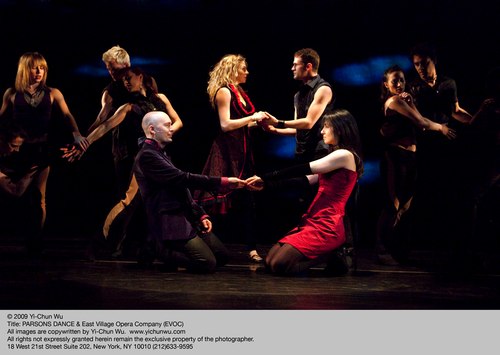
As part of the Bryant Park Fall Festival, Parsons Dance will perform at 6pm. They're doing their rock opera "Remember Me," which I reviewed when it premiered last year.

It's a nice day and a good company...so it's worth going if you're around!

Monday, January 19, 2009

Works & Process: NYCB Emerging Choreographers

The “Works & Process” series at the Guggenheim Museum offers an inside look at art and, more importantly, its creation. In many instances, especially with dance, the time leading up to performance can be more interestingly layered, meaningful, and precious than the final product. This week’s program offered a delightful glimpse of New York City Ballet’s “Emerging Choreographers,” whose new pieces will premiere at the David H. Koch Theater later in the company’s winter season.

A panel discussion with the two featured choreographers, Melissa Barak and Douglas Lee, opened the evening with moderator Ellen Sorrin. They explained their opportunities involved in the New York Choreographic Institute, an affiliate of NYCB that provides new choreographers with a criticism-free landscape to experiment with their ideas. Barak, a former NYCB dancer herself, attended the workshop in its inaugural year (2000) and then three additional times. It was here that she was truly introduced to the art of creating dance, she said. Lee, on the other hand, had been creating works before he attended his two years at the Choreographic Institute. A principal dancer with the Stuttgart Ballet, he came to create his new work on NYCB without knowing any of the dancers.

After the introductory speaking, Barak’s dancers came out for a presentation of what her rehearsal process was like. Her corps de ballet consisted of some of the newest members of the company: Sara Adams, Megan Jonson, Rachel Piskin, Kristen Segin, Mary Elizabeth Sell, and Lydia Wellington. Principals Sara Mearns and Jared Angle completed the cast.

Barak ran through a brief section of her ballet without music, clarifying details of arm movements and changing minor head positions to her liking. The dancers, in their average rehearsal leotards, tights and warm-ups, repeated her wishes without a word. Later the lead couple worked through a lift, laughing as they struggled to get the right momentum to move on. It was nice to see the dancers in a more casual atmosphere learning rather than showing off in performance.

Following the demonstration, Barak spoke with Sorrin about the theme of her piece – wanting to discover the old within the new. She said that she wanted to go back to what Balanchine had done in creating a great ballet and make something that looked like it had been around for years as opposed to something more contemporary, like Lee’s piece. With a completely different, less classical movement vocabulary, Lee’s work “Life Casting” plays more off the individual styles of his dancers: Kaitlyn Gilliland, Maria Kowrowski, Adrian-Danchig, Waring, Robert Fairchild, and Amar Ramasar.

Excerpts from the piece were danced smoothly, but the small size of the stage seemed to inhibit the beauty of the great height of Kowrowski and Gilliland. Both of their separate pas de deuxs were luscious and circular, inhabiting Lee’s swooping choreography. Robert Fairchild’s sections were particularly abstract yet deep. He joined the choreographer for a brief discussion after he danced.

Lee’s tease with the dancers and Barak’s sample of her romantic pas de deux promise great things for their final works. It should be interesting to see how they fare in the full lighting, costume, and breadth of the stage this season. Barak’s ballet will premiere February 17. Lee’s work will premiere January 22.

(The Works & Process program repeats tonight, Monday Jan. 19 at 7:30pm at the Guggenheim, 5th Ave @ 89th Street)

Saturday, May 24, 2008

recent reviews posted

Since I've been behind in my blogging I haven't posted many of the reviews I've been writing on here, but they HAVE been going up on ExploreDance. Here are links to the most recent ones if you want to check them out...

-Dance at DiCapo
-Cedar Lake Glassy Essence
-NYCB Bernstein Collections
-TAKE Dance Company

ABT's Corsaire review to come soon...other performances coming up include an NYCB dinner event, Cedar Lake's spring season, Trinayan Collective Dance, and more.

Plus I've made some updates to my website, which celebrated its 1 year anniversary recently :)

Sunday, May 4, 2008

procrastination

Tomorrow is the last day of the semester and I have two big papers due by noon...both of which I must finish tonight!

I spent most of the day avoiding this moment where I finally have to sit down and work, haha. I had rehearsal early, and then went straight to NY State Theater for NYCB's all Robbins program. I'm writing a real review for ExploreDance but...

Fancy Free is one of my favorite ballets, and it was so good today! Marcelo Gomes from ABT was guesting and it was so fun and...free, hah. Dybbuk followed, but it was SO long and dull compared to the first one. Janie Taylor was beautiful though. West Side Story Suite finished the program with the same cast I saw do it a few months ago. So good.

Then I went to dinner with a friend I haven't seen in a long time...this has been a week of reminiscing, haha. I've heard from a few people I haven't talked to in years, and I literally ran into 2 others today between the theater and dinner. The dance world is so small, haha.

Okay, off to FINALLY do work. Hopefully tomorrow I can post about being done for the semester!

Monday, April 28, 2008

Cedar Lake Review

Should be on exploredance soon...even though we were allowed to take pictures, my camera was acting up so I enjoyed it without the lens to my face and thus have nothing to show for it except my words, haha. Any bloggers want to lend me pictures? You can see other blogger reviews here from Matt, Evan, Philip, and Tonya. And the Times review here.

Cedar Lake's Glassy Essence

Cedar Lake Contemporary Ballet has been at the forefront of innovation in dance since its inception. Their newest venture, “Glassy Essence,” is a performance installation unique to the company’s greatest resources: its wealth of dance talent and its luck of space freedom. Highly publicized online through their website glassyessence.com, the process is just as interesting as the product.

Throughout the performance, which runs twice a night for two weekends in May, dancers move about the company’s vast, open theater space that has been emptied of seats and wings. Here, there are no boundaries. The audience is part of the performance, moving amongst the constantly shifting exhibits of dancers, sometimes retracting back in discomfort, sometimes aggressively getting in the way of the action.

A panel of marley dance floor circumscribes half of the space. The center backdrop is like a cubed climbing wall, with squares poking out at various depths and heights. A raised stage slightly larger than a pool table sits at the middle of the room, surrounded by an unsure audience waiting for lighting cues to signal the start of their interactive experience.

As the dances come out and step off the dance floor into the crowd it’s like they purge from a magic mirror. Suddenly an idolized image becomes real. The dancer is a person, not a fixture on an untouchable stage. And yet they remain in their own reflective world, refusing to make eye contact but sifting through the audience with high sensitivity. The audience revokes as if the dancers’ auras cast them aside.

Gravity is nonexistent in their world that collides with ours. Large hang-gliding like structures harness the dancers at one point, allowing them not to fly carelessly but to slow down weight. Partnering with this quality is impressive, as two dancers waver above the raised stage, or the men stand upright on each other’s shoulders.

They defy reality even without special effects. As men sit on the cube wall they hold the women with their feet under their arms as if they just caught them from falling off a cliff. Danger isn’t an option, though. The hanging ladies swim and waft through space as if their air were heavy, imprinting their beauty invisibly on their atmosphere, not ours.

This is where dance is headed. Parts are reminiscent of a nightclub with flashy lighting and tight crowds, but the engagement of the audience in movement appeals to the new generation of dancegoers. While boundaries are broken, the dancers are still otherworldly. There is so much going on that it is difficult to catch many moments. But no performance will be the same, the exciting nature of this type of work.

Times at midnight

Lately in my late night ways, particularly since I started the Writing on Dance course at DTW with a New York Times critic, I've taken to refreshing the NY Times' Dance page repeatedly until tomorrow's reviews are put online. I'm rarely in bed before at least 1am nowadays, so as I'm doing my work I keep checking to see what new 300 word critiques I can read and critique myself.

I go through time spurts where I never make it to a theater to see dance and don't really mind because I'm distracted by so many other things. And then I go through periods, like now, where I can't get my hands on enough tickets (press, comps, or paid) to performances because there's so much I want to see that I HAVE to make time for it. I've been very fortunate to get into some great shows the last few weeks, and this week I spent literally every night from Wednesday to Sunday in some theater or another - not dancing, but watching and writing.

It's made me more inspired to write quickly, too. I used to see something, wait a day or two until I had a free moment, and then writing a blurb about what I saw. Lately I've been dashing to my laptop as soon as I get home from the performance...or sometimes even on the way home if Starbucks is still open, haha.

Anyway. This Writing course has also gotten me more into reading criticism. Before I would skim the Times dance page to see who had been reviewed and what the pictures looked like, only reading in detail if it was something I had seen or was going to see (but not review). Now I'm obsessed with reading everything that comes off the Gray Lady's dance page (or...its internet page, admittedly), and as soon as it comes out. No time in the morning, I need me news at midnight, haha.


I was rooting for Rebecca Kelly to get a review over the weekend but if it wasn't published by now it probably won't be. Too bad...they deserve the publicity, good or bad! That's one of the issues I find really interesting in dance criticism: who is worthy enough to be reviewed at all. With so much dancing happening in New York City it seems like there should be some way to document it all...I suppose the internet is helping with that, but not entirely...

Sunday, April 27, 2008

Dance at Dicapo review

One more review down...many to go...this should be on ExploreDance soon.

Dance at Dicapo

The Dance at Dicapo program included a poetic, resonant work from the Dario Vaccaro Dance Project sandwiched between two cheesy premieres by The Nilas Martins Dance Company.

New York City Ballet Principal dancer Nilas Martins founded his pickup group in 2003 and today borrows dancers from NYCB and Complexions Contemporary Ballet, among other companies. Despite the talent well of his dancers, the inherent problems in putting together a mish-mashed troupe were evident in Sunday’s performance.

It opened with “Nocturne,” which Martins co-choreographed with John Selya, a former American Ballet Theater principal and star of Twyla Tharp’s Broadway hit, “Movin’ Out.” The piece showed more than adequate influence from Selya’s Broadway days, with 5 Billy Joel songs as accompaniment just for starters. The musicians remained onstage throughout the entire program, and partnering tricks and playfulness were reminiscent of Tharp’s choreography. But where her commercial work meshed theatricality with art seamlessly, “Nocturne” stumbles slightly.

Three of the four men appeared in “Movin’ Out” in some capacity while it was running (Benjamine Bowman, Alexander Brady, Eric Otto). Theirs, and NYCB soloist Ask la Cour’s, boyish charm and technical finesse saved an otherwise cliché work. Parts of it seem like a desperately trying lyrical competition number, such as a solo for Christina Dooling (Complexions). Her confident presence is the only thing that makes the choreography work.

Martins’ “SwingFlight” is only slightly better. The dancers come from such varied backgrounds that it’s like watching four different shows when they dance together. Perhaps more rehearsal time would have improved this, but given the fact that he did manage to borrow skillful dancers from great companies, Martins pulled it off.

Similar to the opening piece, “SwingFlight” is a showy work with a live band and girls in brightly colored dresses. Of the 5 movements, the pas de deux between Drew Jacoby and Rubinald Pronk (both from Complexions) was the most exciting and the least overtly theatrical. Jacoby resembles an early Cyd Charisse with her long legs and sassy style. She has a natural presence that the other ladies lack somewhat. Pronk’s flexibility is admirable and grounded in strength.

Martins danced surprisingly little for his own program, but he and the other men were a vibrant force. William Lin-Yee (formerly of NYCB) stood out for his playfulness. La Cour’s technique was a smooth as the background jazz music.

Compared to Martins’ smiley, in-your-face pieces that flaunt his dancers’ proud strengths, Vaccaro’s “Seguiti” was a welcomed dose to calm the pace of the program. Meaning “to continue on,” “Seguiti” is a more abstract work that explores change and pursuit.

In dull colors and poetic music, it begins with a man walking across with a suitcase, soon followed by another male traveler and two women. Between fragments of duets and ensemble moments, the dancers frequently flutter their hands in front of or beside their face, almost imitating common hand gestures referring to “talking” or “crazy.” The theme of covering each other’s eyes with their hands also reoccurs.

There are times when it’s difficult to determine where the audience should be looking, as a couple dances downstage while a single girl moves sensually in a calm light far away on the opposite side. But the challenge seems to have significance rather than being a choreographic mishap. There are also moments of humor – a male dancer crossing the stage with his suitcase wearing red high heels, another male answering a loud telephone from the audience under the spotlight. Qualities throughout the piece vary, exemplifying Vaccaro’s essence of “change.”

Peter Martins sighting

Just back from seeing 'Dance at Dicapo' where Nilas Martins & Company performed...full review to come in a little while (writing as we speak...)

Granted it was his son's performance, but I was still surprised to see Peter Martins in the audience. Maybe I shouldn't have been. But being a relatively small theater and small performance (especially compared to his company, NYCB)...nice to see support! It was a full house, anyway.

Review to come.

Saturday, April 26, 2008

Times' Sulcas on Yasuko

NY Times review on Yasuko Yokoshi's "Reframe the Framework DDD", which I saw and reviewed Thursday night...

I think I met Roslyn Sulcas without knowing it was her, haha...Claudia was talking to our Writing on Dance class and I stepped away for a second, came back and another lady was talking with us about dance criticism, but nobody caught her name. She sat with Claudia and then this review just came out, so I can only assume it was her, haha!

Friday, April 25, 2008

Youth in Yasuko's "Framework" review

completed review of Yasuko Yokoshi's "Reframing the Framework DDD" at The Kitchen tonight. Not being posted anywhere else since it's just for my Writing on Dance course at the moment, but enjoy. May help to read the previous post before this one...FEEDBACK WELCOME and encouraged. I'm trying to improve my writing through this class and otherwise...

Youth in Yokoshi’s Reframing the Framework DDD

“Talk with Mom so she doesn’t think I hate her.” “Finish that essay.” “Science class.”

Everyday high school kids from suburban Vermont shout their daily tasks. But “perform a groundbreaking live dance drama in New York City” should be added to their modest list.

Nine students from Brattleboro School of Dance perform in Yasuko Yokoshi’s “Reframing the Framework DDD,” a recreation of choreographer David Gordon’s 1984 piece “Framework.” Through a marriage of video, dance, and spoken word, we learn more about these kids in one hour of performance than any casual conversation or flimsy Facebook profile could reveal.

Videos of interviews with the students play as the backdrop to the teens, who recount anecdotes of friendship, cattiness, sisterhood, and first kisses. Their words are powerful. Resonating, each story is told with mundane facial expressions. Dialogue is interspersed with gestures representing punctuation marks - a jump for an exclamation point, a curved hand for a comma, a stomp for a period. Even the squiggly hyphen used to sign off in today’s email jargon is embodied with a worm-like movement when one dancer completes a touching monologue, where she reads aloud an email about her depression.

Their nil default emotion is occasionally freed with yells of frustration and then immediately recuperated. The angst of teenage-hood is hidden beneath their young eyes, trembling behind unquivering lips, boiling below broken out skin. And it is all released when they go silent and just dance. It’s the heart moving moments – the separation of lifelong best friends, the awkwardness of sexuality – that are expressed entirely through motion.

“I enjoy dancing,” one says briefly, with a straighter face than a serious student perfecting plies. Hinting at irony, she continues. “It makes me feel good. Free. Happy.” Their ability to mask this with empty expressions while physically embodying that joy is commendable given their youth.

An orange rectangular outline the size of a doorframe is often shape-shifted between them, usually moved by Andrew Marchev, the only male in a sea of gaggling girls. The frame reverts back to Gordon’s original choreography, which is screened just long enough, at the very beginning and end, to give the live work context. Where the 1984 piece commented on the communication technology of the telephone, Yokoshi’s interpretation gives relevance to today’s conversational conventions, including Myspace and typing abbreviations like BTW (by the way) and G2G (got to go).

Yokoshi has created much more than a dance docudrama. This is a live, ephemeral vehicle for these kids’ experiences that gives each the opportunity to be his or herself and explore troubled emotions further. We meet them and hear their stories. We attach emotionally and see them grow. By the end, we care deeply about who they are, expressing as dancers and as humans.
After the bows the video continues with outtakes. Two girls gossip to the camera. “Like, what if we perform it well but people just don’t like the piece?” they ask sarcastically, igniting a laugh from the audience. There’s no adolescent annoyance here. The piece is a youthful breeze in the stark wind of contemporary dance.

Thursday, April 24, 2008

Yasuko's show saves my day

Gosh, I had a really rather awful, insane day today. Moreso than usual.

LUCKILY I was saved tonight by a WONDERFUL performance at The Kitchen. Yasuko Yokoshi's "Reframing the Framework DDD" is so good, and if you don't have plans to see it this weekend you need to rearrange your schedule immediately. I had to go and review it for my Writing on Dance course (still the highlight of my week) and all of us sat together...and it was great...

The piece brings a group of senior high school students from Vermont into a recreation of David Gordon's 1984 piece "Framework." We watched a clip of it in class before heading over to The Kitchen all together, but this work stands on its own without any prior knowledge necessary of the original piece. I'm doing a full review to be posted later tonight or in the morning, but wow. Good stuff.

See Claudia (teacher of my beloved writing course)'s feature about the work in Sunday's NY Times here. Tickets here.

My review to come soon. It was a nice night after a hectic day...my first time at The Kitchen, which is a nice downtown space. And a (Village Voice dance critic) Deborah Jowitt sighting. And before the show I was talking with some classmates and Claudia about the lack of full time dance critics. I think we established that Alastair at the Times is the last one in the US actually on staff at a mainstream publication. Oy.

Anyways...go see the show if you can. It saved me from going insane tonight, haha.

Monday, April 21, 2008

Times on Kirov/Balanchine

And so Macaulay's final foray from the Kirov's season comes...

I'm a little confused by it, though...he argues both that the Kirov's style and Balanchine's style are exceedingly similar and that there also is a huge gap between the two:

First, "When you watch the Kirov dancing any Balanchine ballet, you see how strong a stylistic connection still runs between the two."

Later, "But it’s also true that the Kirov dancing almost any Balanchine ballet will show how deep the chasm is between these two ballet cultures."

Okay...

He didn't like "Rubies," which was my favorite of the program...However I do agree with his opinion of Lopatkina.
Just finding it interesting with these performances to see all the different critical perspectives. There is so much history and such a complex context with which to place this season and judge it, particularly the Balanchine program. Very interesting.

Sunday, April 20, 2008

"one should have something to be correct about"

Go read Joan Acoccella's New Yorker piece on the Kirov's season. It's exactly what I was getting at in my initial response to last night's performance but didn't know how to say, and of course she has said it perfectly...

The first half of the article is on a puppeteer whose work I didn't see, but the second half describes the ballerinas and their fault: all technique and no emotion. She prasies Diana Vishneva (who I didn't see this time around but caught her solo season earlier this year) for having meaning behind her dancing, being able to play with the music and create nuance.

"Somova’s other attractions include a lovely face, and hair the color of Barbie’s. She also has the emotional range of Barbie."

I also didn't see Somova, but this could be said of many of the dancers onstage.

"Vishneva seems to know why she is dancing—what it is that’s important about the ballet she’s doing—and this knowledge translates into phrasing, which is the dancer’s primary dramatic resource. As she inflects the steps, she is taking you somewhere, and you follow her bug-eyed, whereas, with many of her colleagues, you could go out into the lobby and get a drink of water, and, when you came back, they would look as though they were doing the same thing as before.....she is a lesson, from which the company could learn. Correctness is fine, admirable, but one should have something to be correct about."

Exactly my feeling about the performance I saw and about ballet in general right now. Why bother with perfect lines and extensions and precision if there's no meaning behind the art?

Russian Flavor to a NY Staple

okay, my insomnia led me to my official review last night...should be up on exploredance soon


Russian Flavor to a New York Staple: Kirov Does Balanchine

To have the Kirov Ballet performing in New York City is a treat in itself. But to have the troupe of perfect bodies and technical epitome dance repertoire that is typical for New York audiences but with a taste of Russian flare is a sweetness like no other. Such was the case at Saturday evening’s all Balanchine performance at City Center, the last of the programs the elite company brought with them on their 3 week tour from their home at the Mariinsky Theatre in St. Petersburg, Russia.

The program commenced with “Serenade,” his first ballet choreographed in America (in 1934) after leaving Russia, where Balanchine himself trained at the Mariinsky Theatre. It was a fitting piece for the lavish corps de ballet and the delicious Tchaikovsky score, but if the evening were a decadent dessert to await, this ballet was the cumbersome course to get through before the sweet stuff. Though Ekaterina Osmolkina sparkled with her amiable interpretation of the Russian role (one of the lead parts of the ballet is so aptly named), the rest of the piece was no standout compared to the numerous companies that perform it.

One memorable moment of the choreography is when a male promenades a ballerina from her bottom leg hidden by her tutu, appearing as if she were impressively spinning independently like a dancer in a music box. Saturday it was disappointing. The partner’s hands accidentally wrapped the voluptuous skirt around as well, making a mess of the illusion. Often the ostentatious takes on Balanchine’s exaggerated upper body style were over the top for the proximity of the audience in City Center, though the overextensions may be appropriate at the company’s home theater.

A craving for something more was quickly fed with “Rubies.” The slinky, jazzy section from “Jewels” brought a tart spark to their fine technique. Olesia Novikova was outstanding as the crackerjack lead. Her carved lines could scoop gold out of thin air with their perfection. Balanchine’s staccato playfulness in her pas de deux with Leonid Sarafanov gave them a charming chemistry. Nadezhda Gonchar’s precision and strength kept her grounded in the quickness of the choreography while giving her the freedom to explore a unique flirtation with the audience. By far, this spunky side of the company was most enjoyable.

“Ballet Imperial” concluded the evening with a sugary rush of beauty. The work, which is now known in America as “Piano Concerto No. 2 in G Major,” is one of Balanchine’s more classically driven ballets. Cotton candy pink dresses melted into the taffy quality of the corps de ballet’s dancing. Weaving and intertwining patterns lent themselves gracefully to the languid arms of the Russians. However there were times when, along the sides framing the flavorful Uliana Lopatkina and Igor Zelensky, the corps looked comparably stale.

Yana Selina and Svetlana Ivanova were exquisite in their featured corps roles, raising the question of how a hierarchy structure is imposed on this company loaded with brilliant bodies, luscious movement quality, and a presence that serves any audience’s palate worldwide. New Yorkers must have an appetite for more of the Kirov after this 3 week glamour sampler.

Kirov does Balanchine

I finally got to see the Kirov perform tonight - their second to last performance here after 3 weeks at City Center. I would have loved to have seen all of their different programs, but there's only so much time in a week haha. So tonight I saw the Balanchine program.

I'm writing a real review for exploredance (and my crit course...) but my thoughts for now...

they are all such incredible dancers. their feet and legs and everything are just amazing. wow

the program was Serenade, Rubies from Jewels, and Ballet Imperial. By far my favorite was Rubies. Serenade is a gorgeous ballet in itself, but maybe because I've seen it too many times I didn't think it was anything special tonight. I just saw it on the same stage when PA Ballet did it in November and yes the dancers are far different, but I don't know. Rubies was a huge treat, though. Amazing. Ballet Imperial was the only one I hadn't seen ever before and it was pretty...

Maybe I'm going through a phase since I've seen a lot of contemporary dance lately, but, and I reeeeally hate to admit this, I was almost a teeny tiny bit bored tonight. I shouldn't even be writing that casually about a company so great - and they ARE incredible - but after seeing some deep downtown stuff recently that dug further than just 'being pretty' it was kind of a lot of superficial stuff.

I'll probably erase the above paragraph in the morning when I've come to my senses after thinking about the performance and what I'm going to write in my actual review...but that was my initial thought despite the immense talent of the company.

Sunday, April 13, 2008

reviews & rehearsal

My two recent reviews for ExploreDance have finally been posted:

Petronio here
Ballet Tech here

News of the day is that I started rehearsals this afternoon for this little performance in May. It's part of the New York's Amazing Play festival, and a girl who takes class with me sometimes is directing a short piece and asked if I'd be a part of it. I haven't gotten a chance to read the full play yet so I'm not sure where our dance fits in, but it's me, the director, and one of the actresses that do a dance to "celebrate spring." It's pretty! It's something to look forward to anyway...a week of shows before I start the ABT intensive (which I just received paperwork for...amusing...I'll leave it at that for the moment...) so it should be fun.

After rehearsal I had a private with my teacher like last week, and she basically killed me again, haha. I'm already sore. It's a good soreness though...if there is such a thing.

Anyways...lot's going on in the week ahead. I've finished 2 big articles and have 1 more to go before tomorrow...I get to dance in my usual rehearsals this week because one girl is out so I get to fill in...and some other busy stuff going on. Fun fun.

Saturday, April 12, 2008

"big" ballet & outkast

As revealed the other day, I'm doing an article on Atlanta Ballet's collaboration with Big Boi from Outkast in the new work "big," which premiered Thursday night in Atlanta. You can see video of a rehearsal of the piece here.

Here's their NY Times review. "Ballet can’t achieve modernity by association, only by an extension of its own physical laws and principles." Hmm.

I love how the Times only covers out of town when it's reeeally important.

Also since I was working on my piece yesterday and searching to see how opening night went, I was slightly annoyed to have to wait until NOW to get a review. No bloggers in Atlanta posting immediate feedback?

Friday, April 11, 2008

MANDANCE

This writing course has made me really inspired to write...here is my review from last night's performance of Eliot Feld's mandance project. Should be up on exploredance soon, but this is the longer version...warning: it is QUITE long.

One of the things we discuss in the course is the balance of judgement versus description in a review. Until recently I found it hard to DESCRIBE a dance visually with words, but now I'm finding that my whole review is description! Hopefully the way I describe conveys my opinion about the piece...comments/critiques welcome! I'm in a learning phase...

Mandance Succeeds Again


Eliot Feld’s MANDANCE PROJECT has been a returning event to Joyce Theater audiences for the past four years. The 2008 season, which runs April 9-20, proves why: with two premieres, exquisite dancers, and an artistic team that steals the show, MANDANCE PROJECT is a treat of a showcase for this artist’s work.

His 2004 dance, “Backchat,” kicks the program off with high energy. Two oversized stage lights sit on either side of a large dismembered wall. A pair of legs appears upside down from atop. Soon two other pairs emerge. What unfolds is an athletic act of climbing for three men who retain the strength of a sportsman and the finesse of a dancer.

Often their molasses movements turn to sharp wiping motions with hands taut with tension, a contrast that repeats. Each jumps in unison to catch himself mid-air, legs spread and head thrown back as if holding on for dear life. One can easily forget the floor is there. They interweave with each other’s bodies but always have contact with the wall. They are fearless and as vibrant as their bright costumes: colored shorts and biker shirts that are revealed to be all black on the front when they face audience.

The final image is of them hanging upside down like young boys on a jungle gym, with their legs swaying overhead as if to say, “Look what I can do,” tauntingly. Even after their bow, they hurdle up to the top of the wall for a final humble glimpse of the audience.

“Pursuing Odette” is the most emotionally moving of the works. The solo for Ha-Chi Yu portrays, if somewhat abstractly and in non-narrative form, a dancer’s struggle to attain the perfection demanded by ballet. It reflects remnants of influence from the title character’s original ballet, “Swan Lake.”

There is the sense of a yin and yang tension between the lithe, ethereal qualities of classical dance and the grounded realism of modern dance, a dialectic that is exemplified by not only the choreography but in the costume and scenery. Ms. Yu wears a long black dress with one leg bare and the other strictly suited up in white tights and a pointe shoe. The backdrop is split diagonally in half, part black, part white. However the dividing line in the choreography is less concrete.

It is the simple alterations in recognizable swan-like poses that make Mr. Feld’s movement so effective. A sleeping swan turns into shuddering unrest with flexed ankles and bent knees. An iconic swan attitude position features the head to the sky with arms floating back as wings, knee gently arced so that the foot nearly touches the dancer’s bun. Mr. Feld’s interpretation is angular and severe. Ms. Yu takes a hold of her foot behind her head and slowly tilts forward in a penche. Her shakiness may have been a balance problem, but it only served to better exhibit the trembling nerves in her angst.

Another swan-like position is on the floor, where Mr. Feld continues the concept of connection by attaching the foot to the forehead where the traditional swan would be aloof. At first, the bare foot is the one to touch, but in the ending position it is the pointe shoe, together with her hands as the beak, that create the swan image, suggesting that she indeed has conquered her pursuit.

Traditionally, Odette is a Swan Princess, a delicate beauty and a role aspired to by many a budding bunhead. Here, Odette is the sun, the eye of perfection Ms. Yu longs for. Perhaps she herself has gone through this struggle like so many other talents – the aspirations of ballet depreciating, resorting to the freedom and veracity of modern dance. Her anguish and disparity could strike a chord in any dancer whose dream may be unrealized.

The premiere of “Undergo” is extremely anticlimactic after Ms. Yu’s moving distress and passion. Wu-Kang Chen leads the quartet of dancers with great strength, but he cannot save the work. There is no apparent association between what is happening onstage. A trio undulates and wavers constantly to a discordant soundtrack from choreographer Meredith Monk. A clump of plastic resembling cellophane sits downstage, which Mr. Chen later crawls around in to no end. A lengthy roll of gold paper hangs from the top of the stage, which Mr. Chen later pulls down and envelops himself in like a small child engulfed in wrapping paper on Christmas morning. The meaning is unclear.

Luckily another premiere, “Isis in Transit,” provides a welcome relief. Based on the Egyptian tale of Isis, the goddess of fertility, and her journey for the scattered remains of her brother Osiris, the work presents the strikingly fit Fang-Yi Sheu struggling through various set pieces in conquest. The same crumpled paper that was offsetting in the previous work now hangs across the black backdrop. Low pyramids line the back, and Ms. Sheu climbs and crosses them in profile, mimicking the angled arms and 2 dimensional quality of a painted goddess circumscribing an Egyptian vase.

She then moves to a sea of pliable plexiglass poles for a game with gravity. She grasps a handful to her back and falls forward as though she were going to face plant to the ground. The poles ease her weight and bend time so that she just barely skims the stage with her breath before returning back up to standing. She battles, turning horizontal and upside down within the forest of clear stems, which glitter in the thoughtful lighting design by Aaron Copp.

Her next stage battle is with a large metal bowl on center stage. She traces the circumference of it with her cautious steps before her entire body spasms to cause the bowl to shake, again toying with the lighting from straight above to create an effect reminiscent of thunder and lightning.

She faces further struggles with scenic elements, designed by Mimi Lien and Mr. Feld. The intricate set could overpower a dancer of small stature, but Ms. Sheu is the one who shines.